The business areas also make decisions regarding production, sales and employees, with the aim of generating a lasting good return on invested capital. Some parts of IT are managed by Group-wide functions in order to leverage economies of scale and risks are handled in line with the Group’s policies.
The Group’s financing and financial risks are managed by Group Finance based on a finance policy established by the Board that is characterised by a low level of risk. This aims to minimise the Group’s cost of capital and ensure the effective management and control of the Group’s financial risks.
Sensitivity analysis
Operational risks
A 1 per cent change in deliveries and the price of the Group’s products or significant input goods is deemed to affect Group operating profit as per the table below.
Earnings are relatively evenly spread over the year. The clearest seasonal effects are lower personnel costs in the third quarter and the fact that electricity production at the hydro power plants is normally higher in the first and fourth quarters.
Holmen hedges part of the electricity consumption at the paper mills. For 2026, price hedges are in place corresponding to 85 per cent of expected consumption and 40 per cent for 2027.
Sales |
Change |
Price |
Deliveries |
| Paperpoard and paper | +/-1 % | 143 | 49 |
| Wood products | +/-1 % | 36 | 10 |
| Wood from company forests | +/-1 % | 23 | 17 |
| Hydro and wind power | +/-1 % | 4 | 2 |
Input goods |
|||
| Wood | +/-1 % | 54 | |
| Electricity* | +/-1 % | 3 | |
| Chemicals | +/-1 % | 18 | |
| Other variable costs | +/-1 % | 8 | |
| Delivery costs | +/-1 % | 21 | |
| Employees | +/-1 % | 30 | |
| Other fixed costs | +/-1 % | 31 |
* Taking electricity price hedges for 2026 into account. Without taking hedges into account, the corresponding impact would be SEK 16 million.
Financial risks
The table below shows the extent of the impact of any change in the Swedish krona, the price of electricity or the market interest rate on Group profit/loss before tax and equity next year, taking account of hedging. The assumed change is calculated based on five years’ average historical volatility for each instrument, which is deemed to be a reasonable change going forward. The historical volatility of exchange rates is calculated based on average annual volatility on the KIX, the Riksbank’s exchange rate index. Excluding hedging, a 5 per cent change in the krona would affect the profit/loss before tax by SEK 464 million a year.
Profit/loss before tax* |
Change |
SEKm |
| Exchange rate total | +/-5 % | 199 |
| EUR/SEK | +/-5 % | 36 |
| USD/SEK | +/-5 % | 79 |
| GBP/SEK | +/-5 % | 49 |
| Other currencies/SEK | +/-5 % | 35 |
| Borrowing rate | +/-1 % point | 10 |
Equity |
Change |
SEKm |
| Transaction hedging | +/-5 % | 531 |
| Investment hedging | +/-5 % | 3 |
| Equity hedging | +/-5 % | 29 |
| Electricity price hedging | +/-60 % | 904 |
| Interest rate changes | +/-1 % point | 86 |
* Estimated effect for 2026 including hedging
Operational risks
Production and deliveries
Risk
Demand for Holmen’s products is affected by macroeconomic and political factors, among others, and the competitiveness of European producers above all. Changes in demand affect the ability to achieve full production at the Group’s industrial facilities and can lead to lower income. Income may also be impacted if the harvesting of our own forests needs to be limited and by variations in precipitation and wind, which govern the production of hydro and wind power.
Risk management
Holmen endeavours to maintain a good cost position through large-scale production at well-invested production facilities, efficient logistics solutions and good control over the supply of wood and energy. Together with longstanding customer relationships and strong product brands, this also increases our ability to maintain a high level of production amid more difficult market conditions. Changes in demand for wood may be catered for by moving the harvesting of our own forests between years, while the production of hydro power during the year can be controlled by regulating water reservoir levels.
Comment
Demand for wood products was subdued in 2025 due to weak construction activity, while supply was constrained by global raw material shortages. The electricity price in northern Sweden was very low for much of the year due to high water flows and a limited transmission capacity, which locked in power generation for much of the time. Wind power production was curtailed partly by low electricity prices. For information about how changes in deliveries would affect Holmen’s operating profit, given the circumstances on 31 December 2025, see the sensitivity analysis.
Selling prices
Risk
The market balance in each product segment governs the selling price and affects income.
Risk management
Holmen is limited in its ability to make rapid changes to its product range in the event of changes in price, but it adjusts its product focus towards those products and markets deemed to have the best long-term conditions and by having a broad customer base and an offering across a number of product areas. Changes in the price of wood can be managed to some extent by moving harvesting from our own forests between years, and changes in the price of electricity can be partly managed by regulating water reservoir levels in order to move electricity production over the year.
Comment
Market prices for consumer paperboard and paper were broadly stable in 2025. Wood product prices rose in the spring but fell back in the autumn, and by the end of the year were broadly at the same level as at the beginning of the year. Electricity prices in northern Sweden were lower in 2025 than during the previous year, but thanks to our ability to steer electricity production to periods when electricity prices are higher, Holmen’s average selling price was 40 per cent higher than the market price in northern Sweden. For information about how changes in prices would affect Holmen’s operating profit, given the circumstances on 31 December 2025, see the sensitivity analysis.
Raw materials
Risk
Wood, electricity and chemicals are the most significant input goods and price changes affect profitability. Holmen’s costs depend on price developments for input goods, as well as on how well the Group succeeds in making its production and administration more efficient. There is a risk that the Group’s costs will increase if there is a shortage of raw materials, or if prices increase for input goods.
Risk management
Nearly half of the Group’s wood needs are covered by harvesting from the Group’s own forests, while the remainder is mainly purchased from private forest owners. The Group’s position when it comes to pulp is largely balanced as a result of the integrated production process. The paperboard business generates almost all the electricity required at its own mills, while electricity for paper manufacturing is supplied from external electricity purchases. The price risk for this consumption is managed through physical fixed price contracts and financial hedging. The Group also sells electricity from its hydro power and wind power assets to the grid. The need for thermal energy is great and is met locally through recovery and production from residual products. Chemicals are a significant input, particularly in paperboard production, but the need is declining since used chemicals are being recovered at the mills.
Comment
The price of wood continued to increase in 2025, with large price differences within the country, while the price of chemicals remained broadly stable over the year. In 2025, 85 per cent of electricity consumption at Holmen’s paper mills was hedged. For information about how changes in commodity prices would affect Holmen’s operating profit, given the circumstances on 31 December 2025, see the sensitivity analysis.
Suppliers
Risk
Deficiencies in the input supply chain in terms of security of supply and quality can lead to production disruptions. Suppliers that do not meet Holmen’s requirements can also have a negative effect on operations. There is a further risk of essential raw materials not being delivered because of changes in laws and regulations or other external factors.
Risk management
Holmen endeavours to have at least two approved suppliers per area of use. Holmen’s Supplier Code of Conduct is included in all new contracts. The Code contains sustainable development requirements, including respecting internationally recognised principles governing the prevention of corruption, human rights, the work environment and the environment. Holmen has engaged an external party, EcoVadis, to monitor suppliers for their compliance with the Code. Compliance with silviculture contractor agreements is ensured through site visits to forests. All silviculture contractors are given annual training, through the silviculture training programme, in silviculture, and in labour law, and are informed about where to turn should irregularities occur.
Comment
The supply chain risks relating to the climate, environment, labour legislation, human rights, business ethics and sustainable purchasing have been mapped. The outcome is monitored through EcoVadis, in discussion with the relevant suppliers. In 2025, no breaches (1) of the Supplier Code of Conduct were reported. In the event of such breaches of the Code, an active discussion with an action plan is put in place in accordance with Holmen’s procedures. Suppliers representing 90 per cent (90) of the Group’s purchasing volumes comply with the principles of the Supplier Code of Conduct. Reducing fossil fuel emissions is discussed with the largest suppliers of input products.
Customer credits
Risk
The risk of the Group’s customers being unable to fulfil their payment obligations constitutes a credit risk.
Risk management
The risk that the Group’s customers will not fulfil their payment obligations is limited by means of creditworthiness checks, credit limits per customer and, in some cases, by insuring trade receivables against credit losses. Credit limits are continually monitored. Exposure to individual customers is limited.
Comment
At 31 December 2025, the Group’s trade receivables totalled SEK 2 398 million (2 823), of which 61 per cent (39) were insured against credit losses. During the year, credit losses on trade receivables had an impact on earnings of SEK -9 million (-). Sales to the five largest customers accounted for 14 per cent (13) of the Group’s total sales in 2025.
Installations
Risk
Production may be seriously disrupted, for example in the event of a fire, machine breakdown or natural disaster. This can lead to supply problems, unexpected costs and reduced customer confidence. Production facilities require ongoing maintenance and technical upgrades. Longer maintenance shutdowns can entail higher costs and a greater loss of production than planned. Investments in non-current assets may also be more costly than initially planned.
Risk management
Holmen focuses on preventing damage through investments, maintenance, crisis management and business continuity planning. Operator training and specific procedures increase both risk awareness and safety for employees. The installations are insured with stable insurance companies at replacement cost and for loss of contribution margin.
Comment
Holmen continuously invests in fire protection and other damage prevention actions. In 2025, Holmen clarified and updated the technical fire protection framework, with an increased focus on the critical parts of the installations. Planned maintenance shutdowns are carried out each year at the Group’s mills and sawmills to ensure continued good production and high quality products. This continuous effort is intended to reduce the risk of serious disruptions occurring.
IT systems
Risk
Efficient IT support is required to be able to manage and plan production, sales and purchasing. Disruptions in IT support and unauthorised access to information can have significant negative effects on the business.
Risk management
Operating disruptions and unauthorised access are prevented by security measures and preventive measures in the form of appropriate physical protection, reliable server operation and secure networks. Measures and procedures are in place to minimise the risk of interruption and to manage situations if interruptions occur. Holmen is continually developing protective measures to address changes in the risk profile.
Comment
To make its systems and procedures secure, Holmen has created a function focused on IT and cyber security. In 2025, a process was initiated to certify Holmen’s management systems that handle information security, cybersecurity and data protection according to the ISO/IEC 27001 standard.
Forestry regulations
Risk
Holmen’s right to manage its own forest is crucial to maintaining its value. There is a risk that the requirements for the forests to be used as carbon sinks may increase in the future. Such a development could affect the ability to manage the forests and therefore access to raw materials. Requirements for changes in forestry practices and further restrictions under the Species Protection Regulation could lead to reduced harvests and increased costs.
Risk management
Forest and land management are regulated both nationally and at EU level. In order to be able to engage in active and sustainable forestry, it is important that laws and regulations do not restrict the conditions necessary for sustainable operations. Holmen participates in national and international industry organisations to exert an influence on relevant political and regulatory issues.
Comment
During the year, the focus was on the industry’s competitiveness and the implementation of EU regulations. In Sweden, studies have been presented that have an increased focus on forest growth and production by the forest industry. Within EU institutions, a greater emphasis has been placed on competitiveness and the regulations are being simplified in several areas. Holmen has continually played an active part in discussions, both on its own and through industry organisations, to influence the EU’s regulations and the Swedish government’s implementation planning, including by highlighting the positive climate effects of an actively managed forest.
Damage to forests
Risk
Wild game can damage forests when grazing, resulting in both deterioration of the quality of the trees and reduced forest growth. Insect pests are another risk factor; for example, the spruce bark beetle can damage spruce forests. Storm and snow damage, fungal attacks and forest fires are other examples of damage that must be addressed and managed in forestry.
Risk management
The Group’s forest holdings are not insured as they are spread across large parts of Sweden and the risk of extensive damage is not considered to justify the cost of insurance. To reduce the extent of grazing by wild animals, active efforts are undertaken on Holmen’s land to maintain game at the correct population level. Insect pests such as pine weevils are combatted by waxing seedlings and infested forest is harvested as soon as possible to prevent spread.
Comment
At the end of 2025, central Sweden was hit by major storms. The volumes felled by storms on Holmen’s land amounted to just over 300 000 m³sub, which corresponds to 10 per cent of Holmen’s normal annual harvest. Holmen’s forest management programme takes into account the increased risks of forest damage in a changing climate and is focused on creating robust forests, with further variation and risk diversification being considered.
Climate change
Risk
Climate change may affect Holmen’s operations, but there are not currently thought to be any major physical risks. Rising temperatures and changes in precipitation patterns may benefit pests such as fungi and insects, which may lead to lower timber volumes and quality. Longer periods of drought and higher temperatures may limit forestry activities due to the ground being frozen for shorter periods or stoppages due to a high risk of forest fires. At the same time, a warmer climate could increase growth, with longer growth periods, more precipitation and higher levels of carbon dioxide, aiding photosynthesis.
Risk management
Each business area has climate adaptation plans that assess how production, products and services are being affected by a changing climate. The plans describe the relevant climate risks, their potential impacts on the business and the activities that can be carried out to seize opportunities and reduce risks. The climate change adaptation plans are reviewed annually within each business area. The management of each business area participates in the process and prioritises any activities, taking the costs and risks of the actions and the other needs of the business into account.
Comment
The market’s ambitions with regard to the combating of climate change are contributing to demand for renewable products and Holmen’s strategy is well positioned in the transition to a low-carbon economy. Increased demands to reserve land for purposes other than forestry may lead to reduced harvests and thus reduced opportunities for the forest to contribute with renewable products.
Environment and permits
Risk
Holmen runs operations that require environmental permits. The permits specify conditions regarding permitted production volumes, noise levels and permitted emissions to air and water, among others. Production disruptions can cause breaches of emission conditions set for the business by the environmental authorities. Such breaches could affect the environment. On sites where Holmen has conducted industrial operations, the need for remediation may entail future costs. Obtaining permits for wind power development often takes a long time and the outcome is uncertain.
Risk management
Environmental measures are organised and carried out in accordance with Holmen’s environmental and energy policy. In the event of process disruptions, the environment takes precedence over production. Risks are prevented and managed through regular maintenance shutdowns and own checks, checks by authorities and environmental risk analyses, as well as through the use of certified environmental and energy management systems and chain-of-custody certification. In consultation with the authorities, Holmen conducts investigations to assess whether former industrial sites need to be remediated.
Comment
In 2025, 42 (46) environment-related incidents were reported to the supervisory authorities. All the incidents were addressed through corrective actions within the businesses’ environmental management systems. At Workington Mill, the implementation of measures to ensure that the environmental permit limits are not exceeded for the water treatment plant is still underway. The supervisory authority has been notified. In 2025, there were no incidents that led to long-term consequences for the environment, production or human health.
Work environment
Risk
Incidents and accidents in the workplace have an effect on human life and health. This can also lead to production disruptions and increased costs.
Risk management
Holmen has a vision of zero work-related accidents and its work environment policy states how work-related injuries and illness are to be prevented. Certified management systems, Group-wide targets relating to industrial accidents, continual training of employees to increase risk awareness, risk observation and incident and accident reporting procedures, and risk assessments of tasks and work by contractors, are examples of activities to achieve a high level of safety in the workplace.
Comment
In 2025, the rate of industrial accidents was 4.7 (5.3) per 1 million hours worked. The most common accidents were slips, trips and crush injuries. The most significant areas of risk involve work with overhead cranes and vehicles with people in movement. Holmen continuously works to strengthen and promote safe behaviour in the work environment through locally adapted activities.
Talent management
Risk
Skilled and motivated employees are key to being able to conduct business operations with good profitability over the long term. There is a structural shortfall in many industrial positions. Skilled labour shortages can delay work and disrupt production.
Risk management
Holmen is working continuously to enhance its employer brand. Each business area prepares a long-term talent management plan each year that identifies recruitment needs. Targeted digital marketing combined with in-person events, such as career days and sponsorship collaborations, are aimed at increasing awareness of Holmen and allowing it to attract and retain competent employees.
Comment
Holmen must be an attractive employer that develops employees through stimulating tasks and new challenges. Employee engagement is measured through annual new hire questionnaires and regular employee surveys. The results are analysed and acted on through local action plans.
Business ethics risks
Risk
Nationally and internationally, customers and partners make demands of Holmen as a stable and reliable supplier that has good business ethics and clear sustainability principles. Deviations from principles and policies could have a negative impact on the Group’s reputation and business relationships.
Risk management
Holmen’s Code of Conduct, business ethics policy and associated guidelines provide clear guidance on how to maintain good business ethics when dealing with external contacts. Holmen’s Code of Conduct also provides guidance on human rights, workers’ rights and the environment. These areas are clarified in Holmen’s policies and related guidelines. Holmen employees are regularly trained in the Code of Conduct.
Comment
In 2025, no corruption-related adverse judgments were delivered against Holmen or its employees. There are also no such cases ongoing in court. Seven cases were reported through Holmen’s whistleblowing service in 2025. No cases of corruption or bribery were identified. Labour law issues were handled by following standard HR procedures.
External risks
Risk
Holmen operates in a global market and sells products to many countries around the world. Because of this geographical spread, Holmen is exposed to political risks, conflicts, natural disasters and pandemics. Moreover, Holmen is obligated to comply with laws and regulations wherever it conducts business, including in areas such as the environment, real estate, labour law and taxation. Changes in laws and regulations may affect conditions for Holmen’s operations and lead to increased costs for regulatory compliance.
Risk management
Holmen participates in national and international industry organisations whose role is monitoring social trends and advocacy work, and that put forward Holmen’s position and view on relevant political and regulatory issues. Contact is established with local representatives and the general public in areas where the Group has operations. This takes place, for example, through consultation and information meetings, visits to sites and meetings with decision-makers. More unforeseeable risks that may arise, for example as a result of disease outbreaks, war or political unrest, are managed through ongoing external monitoring. To maintain optimum preparedness and active crisis management, Holmen is engaged in close dialogue and coordination with industry organisations, customers and suppliers.
Comment
Global trade barriers in the form of tariffs may affect our sales, both directly and indirectly, through altered trade patterns. Holmen’s sales to the US are limited and the tariffs imposed by the United States on other countries have so far only had a marginal effect on the Group’s earnings and financial position. Holmen continuously monitors developments in order to take measures to minimise potential effects. Holmen has been active in promoting the growth of sustainable energy production and bio-based activities, through dialogue, consultation responses, preparedness and advocacy work, on its own and together with industry organisations.
Financial risks
Currency
Risk
The Group’s earnings are affected by fluctuations in exchange rates. Transaction exposure risk arises due to a significant portion of the Group’s sales income being in different currencies from costs. Translation exposure risk arises from the translation of foreign subsidiaries’ assets, liabilities and earnings into Swedish kronor.
Risk management
Transaction exposure. In order to reduce the impact on profit of changes in exchange rates, net flows are hedged using forward foreign exchange contracts. Net flows in euros, US dollars and pounds sterling for the coming four months are always hedged. These normally consist of trade receivables and outstanding orders. The Board may decide to hedge flows for a longer period if this is deemed to be appropriate in light of the products’ profitability and competitiveness and the currency situation. Currency exposure arising when investments are paid for in foreign currencies is distinguished from other transaction exposures. Normally, 90–100 per cent of the currency exposure associated with major investments is hedged.
Translation exposure. The Group’s non-current assets are mainly Swedish, with the exception of the paperboard mill in the UK, which accounts for 2 per cent of the assets. The hedging of the exposure that arises when subsidiaries’ assets and liabilities are translated into Swedish kronor (known as equity hedging) is assessed on a case-by-case basis and is arranged based on the value of the net assets upon consolidation. The hedges take the form of foreign currency loans or forward foreign exchange contracts. The exposure that arises when the earnings of foreign subsidiaries are translated into Swedish kronor is not normally hedged.
Comment
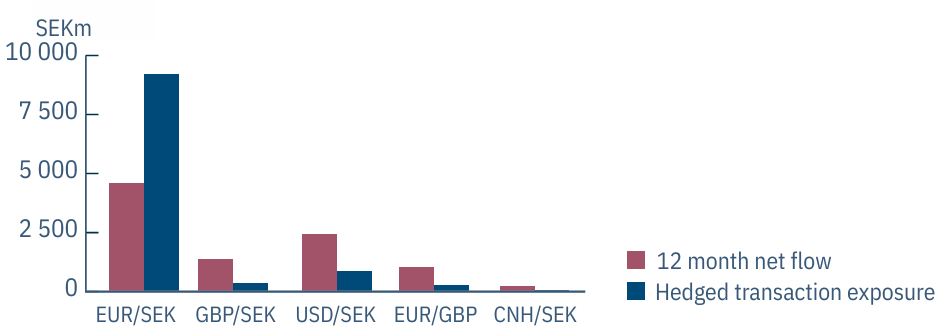
Transaction exposure. Expected flows in EUR/SEK are hedged for just over two years at an average rate of 11.30. For other currencies, 4–5 months of flows are hedged.
Translation exposure. Hedging of exposure to pounds sterling amounted to GBP 60 million at year-end. Net assets in other currencies are limited and are not usually hedged.
Interest rates
Risk
Changes in market interest rates affect the Group’s cost of borrowing.
Risk management
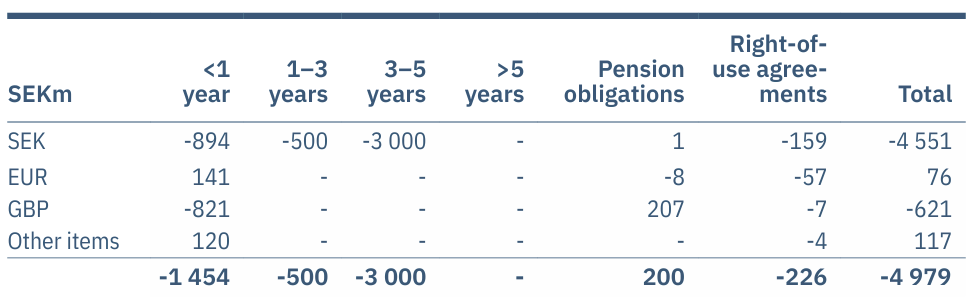
The fixed interest rate period for the Group’s net financial debt varies over time and is decided on by the Board of Directors. To limit the effects of a rise in interest rates, the interest rate on loans may be fixed, or interest rate swap agreements may be entered into without changing the interest rate on the underlying loans.
Comment
Holmen’s average borrowing rate in 2025 was 2.7 per cent.
The table below shows the Group’s fixed interest rate period by currency.
Credit risk relating to financial counterparties
Risk
The risk of financial transactions giving rise to credit risks in relation to financial counterparties.
Risk management
The creditworthiness of Holmen’s financial counterparties is assessed using reputable credit rating agencies or, where a counterparty has no credit rating, the company’s own analyses. A maximum credit risk and settlement risk are established for each financial counterparty and are continually monitored. The calculation is based on the maturity and historical volatility of different types of derivatives. For cash and cash equivalents and current investments, the maximum credit risk is deemed to correspond to the nominal amount.
Comment
At 31 December 2025, the Group had outstanding derivative contracts of a nominal amount of SEK 16 billion and a net fair value of SEK 0.5 billion.
Liquidity and refinancing
Risk
The risk that the need for future funding and refinancing of maturing loans may have to be met at a high cost.
Risk management
Holmen’s strategy is to have a strong financial position to give it room for manoeuvre when making long-term business decisions. The target is for net financial debt not to exceed 25 per cent of equity. Holmen’s financing usually mainly comprises bonds and the issuing of commercial paper. Holmen reduces the risk of future funding becoming difficult or expensive by using long-term contractual credit facilities. The Group plans its financing by forecasting its financing needs over the coming years based on the Group’s budget and profit forecasts, which are regularly updated.
Comment
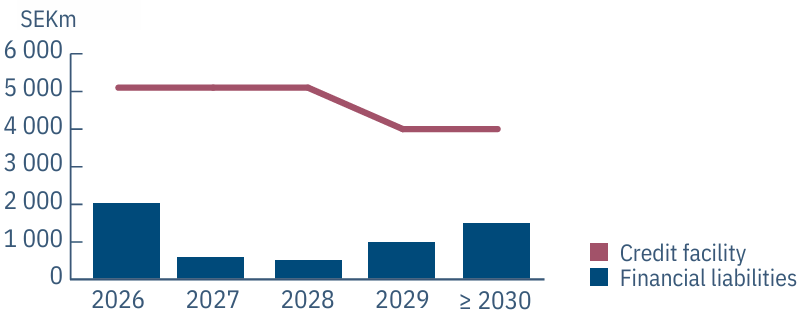
Net financial debt amounted to SEK 4 979 million, equal to 9 per cent of equity. Financial liabilities totalled SEK 5 637 million at the end of the year, of which SEK 2 024 million is due for payment in 2026, and financial assets totalled SEK 658 million, of which SEK 414 million consists of cash and cash equivalents and current investments.
The Group has two unutilised contractual credit facilities totalling SEK 5.1 billion maturing between 2028 and 2030. The facilities include limits that mean that they cannot be used if the net debt to equity ratio exceeds 125 per cent.