

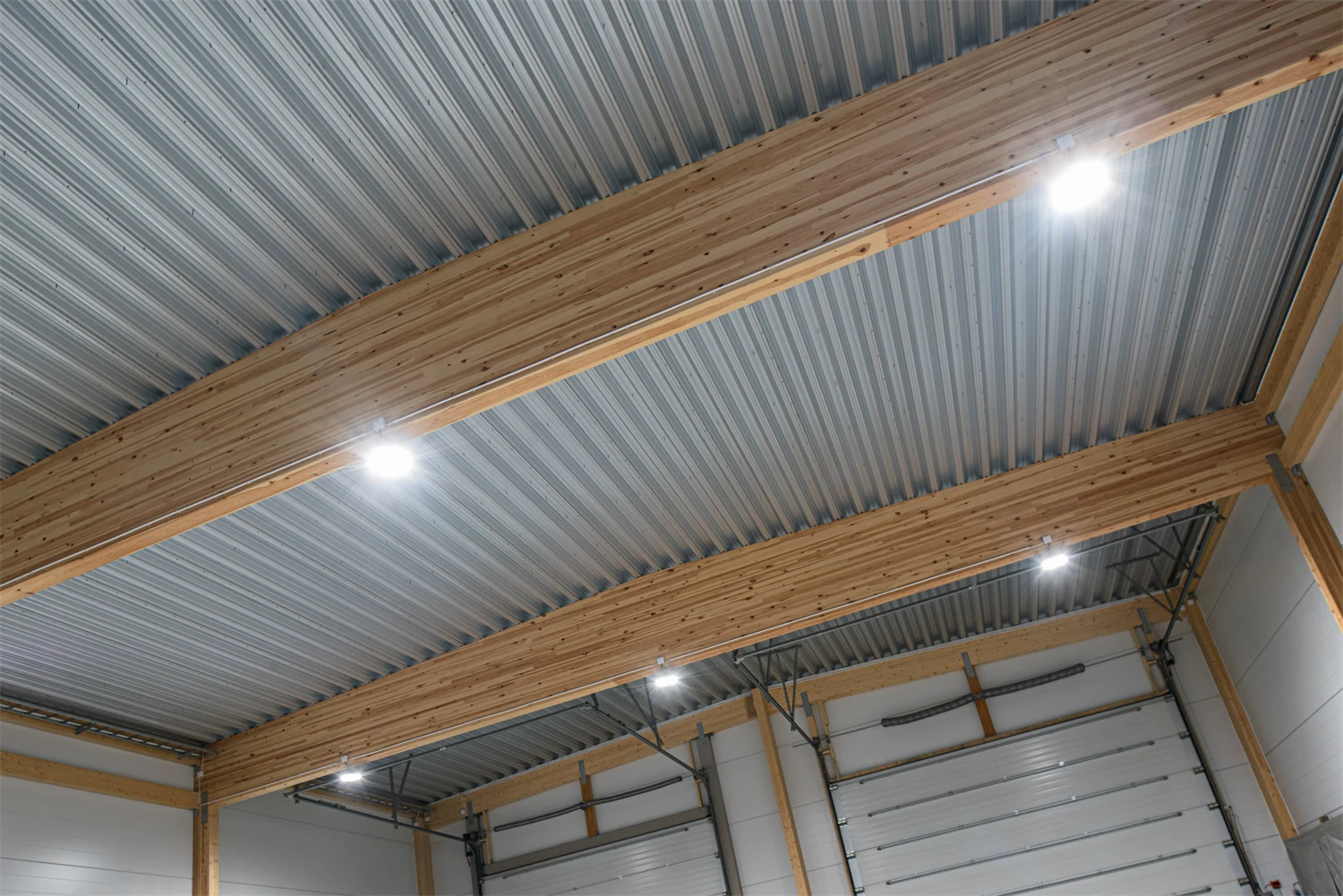
In many parts of the world, pine has been used for a long time – including in glulam and cross-laminated timber (CLT).
“It is mainly in the Nordic countries that spruce has such a strong tradition,” says Peter Andersson, Market Area Manager Scandinavia at Holmen Wood Products.
Historically, spruce timber has also been cheaper, but that changed after the spruce bark beetle outbreaks between 2018 and 2021. Today, prices for spruce and pine are at roughly the same level.
“Pine is becoming increasingly important. It is the future,” says Peter Andersson.
Wood is the best choice
IPM Norden is one of Sweden’s leading companies in advanced surface treatment of steel and concrete for industry, infrastructure and bridges. When the company decided to build an extension to an existing industrial facility in Iggesund, outside Hudiksvall, they chose to build in wood – combining untreated pine beams with spruce columns.
The existing industrial buildings in the area are constructed in steel and concrete. For the new extension, a pre-treatment hall for light blasting, sand sweeping and mechanical processing, wood proved to be a suitable alternative.
Peter Johansson, owner and CMO of IPM Norden, evaluated different materials based on people, technology and organisation. The conclusion was clear: wood was the superior choice.
“I mainly looked at the working environment and cost efficiency. No other material matched wood. For the function of the hall, there were no drawbacks to a timber structure – quite the opposite.”
The hall needed to retain heat in the roof, walls and floor, and thanks to the timber structure, heating costs are now low.
Less dust and a better working environment
In consultation with the developer, a combination of pine and spruce was chosen – a decision Peter Johansson does not regret.
“Whether it’s pine or spruce is less important. What matters is that it’s wood.”
Typically, this type of industrial hall is dusty and difficult to keep clean. In the new timber hall, employees experience significantly less dust than in other buildings on the site. Wooden surfaces are also easier to clean than steel.
“We’ve been using the hall for about a year now, and everyone thinks it’s fantastic and easy to keep clean. Dust adheres more easily to steel. Wood doesn’t create dust pockets, which results in better air quality. The overall impression is that the timber hall is cleaner – and the working environment has improved significantly.”
Lower costs and short construction time
Economy and build time were two other decisive factors in choosing wood.
“For our purposes, there was a big difference in cost between materials. We initially looked at traditional steel solutions, but the evaluation showed that wood not only provided a better working environment – it was also considerably cheaper,” says Peter Johansson.
The construction time was also short.
“It took only six weeks from the concrete slab to a finished hall. Building with wood was quick and smooth.”
Neighbours in the industrial area are curious and think the hall looks great, and Peter Johansson believes more companies will follow their example.
“I’m convinced that more businesses will consider wood as an alternative when developing their operations.”