

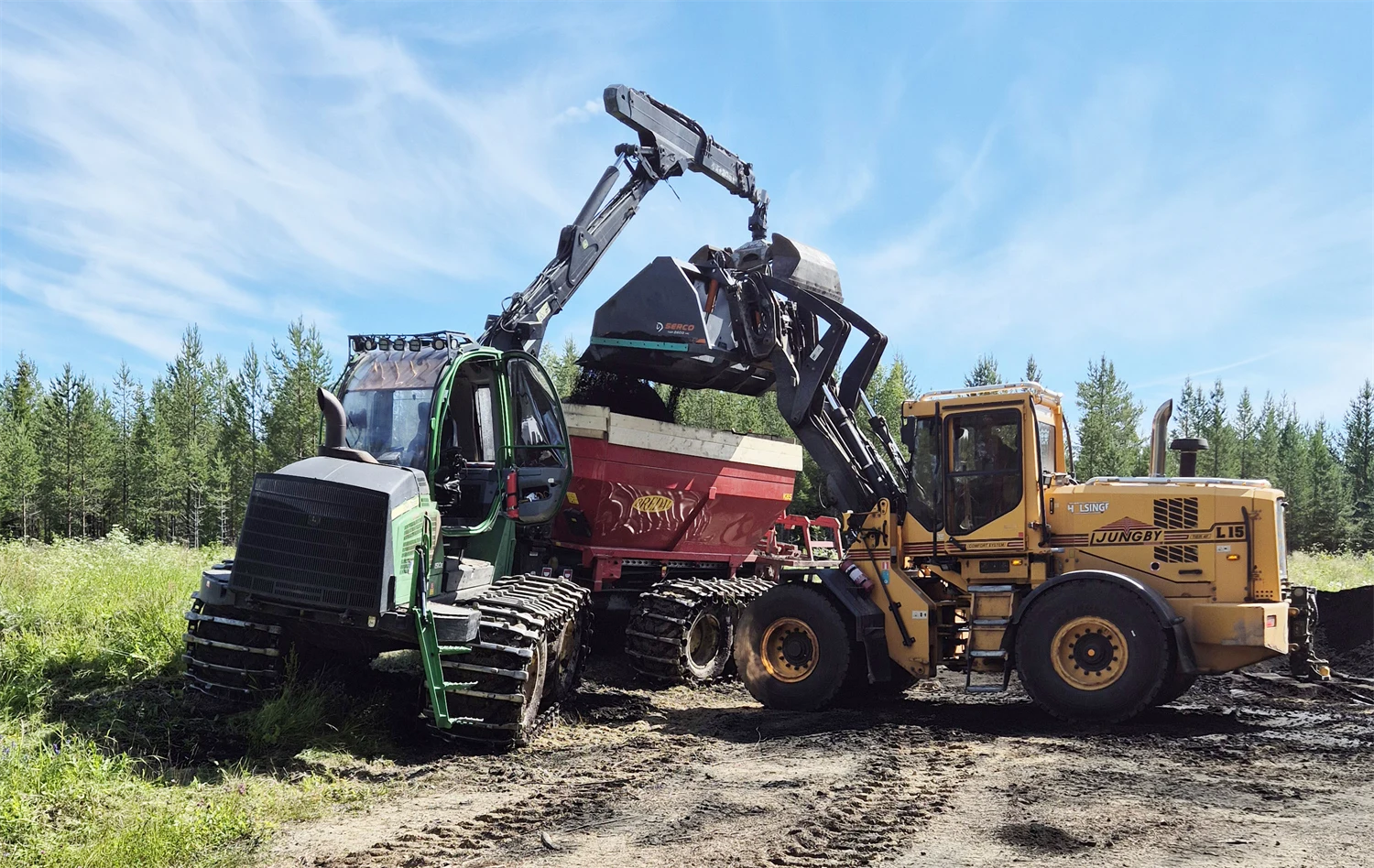
At Holmen's sawmill, sawdust, bark and wood chips are used to produce heat and energy. When the material is burned, ash is formed that previously often had to be stored or sent to landfill. Now it is returned to the forest instead.
"It is actually the only residual product from the sawmills that we have not had a really good solution for. Now we can give back some of the nutritions that were once taken up by the trees", says Peter Holmström, logging coordinator at Holmen Skog.
Minerals back into the forest
The ash contains, among other things, potassium, phosphorus and magnesium, substances that the trees have taken up from the ground during their lifetime. By returning the hardened ash, the cycle is closed.
"Ash return is a concrete example of how we can create more circularity in our operations. We take advantage of resources that are already in our own value stream and put them to good use again", says Marit Bohlin, Sustainability Manager at Holmen Trävaror.
Smarter spreading results in lower costs
The ash is spread with a converted forwarder equipped with spreading equipment. In many cases, the method replaces helicopter spreading and provides both lower costs and good control over where the ash ends up.
"We believe that the solution is both cheaper and easier to plan. At the same time, we get very good control over the spreading, which is important for avoiding sensitive areas", says Peter Holmström.