


Four Swedish and five Finnish icebreakers are working around the clock, but there are not enough resources to go around. The Swedish Maritime Administration has also imposed specific restrictions: only ice-class ships may enter and leave the ports and they must load or unload at least 2 000 tonnes. This affects wood products, since they weigh relatively little. Ahlmark Lines, which operates many of Holmen Wood Products’ shipments, has spoken to the Swedish Maritime Administration about an exemption, but the restrictions have already caused delays.

“This year we’ve had all the elements against us – low sea levels, wind and cold. This leaves the ships vulnerable to getting stuck in the ice, and then it takes extra time to get them out when the icebreaker eventually arrives,” says Per Salokannel, COO at Ahlmark Lines.
Delays to Holmen’s shipments
Holmen’s wood products are normally loaded onboard in the Port of Skellefteå, then the ships head to Iggesund to take on more cargo, before setting sail for their final destination in the UK. But when the vessels get stuck in the ice, it makes planning difficult, not least as arrival times have to be synchronised with the tides at the UK ports.
The delays mean that ships often arrive at low tide, when the ports are closed to traffic, and that creates additional waiting time. The UK has also experienced strong winds this winter, causing smaller ports to close due to high waves.
In addition to the delays, there is the extra cost of the icebreaker assistance. The shipping companies hope that the government will take over responsibility for this the future, in the same way that hauliers do not pay for road maintenance.
While at sea, up to 400 tonnes of ice can accumulate on the deck, cargo and equipment. And the ice has to be removed using steam, crowbars and axes before unloading can begin, which is also time-consuming.
Iciest winter since 2010
This year’s extreme weather may be the worst since 2010, and at times it has caused delays of up to a month to Holmen’s wood products. Ice continues to build up at sea, but is expected to diminish as the sun and spring warmth arrive. The Swedish Maritime Administration’s restrictions will remain in place until May.
“Our operators are in daily contact with the captains so they can plan the shipments as well as possible,” says Per.
However, notifications of weather-related delays are sometimes met with bafflement by customers in the UK, where temperatures are currently far from winter-like.
“Our customers are basking in 16°C and sunshine,” says Andrew Nichols, Market Area Manager for Holmen Wood Products in the UK. “So it’s hard for them to imagine crew battling the elements on cargo ships stuck in a frozen sea.”
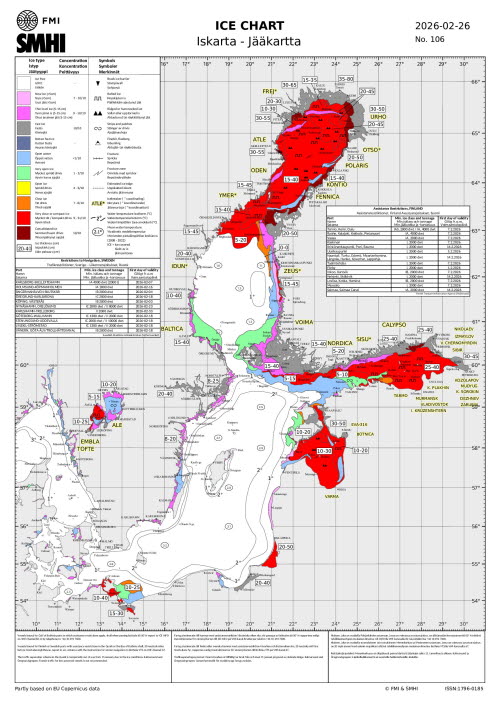
Ice chart for the Baltic Sea from the Swedish Meteorological and Hydrological Institute. The red areas show compact ice.

A crew member chips ice off the cargo on board.
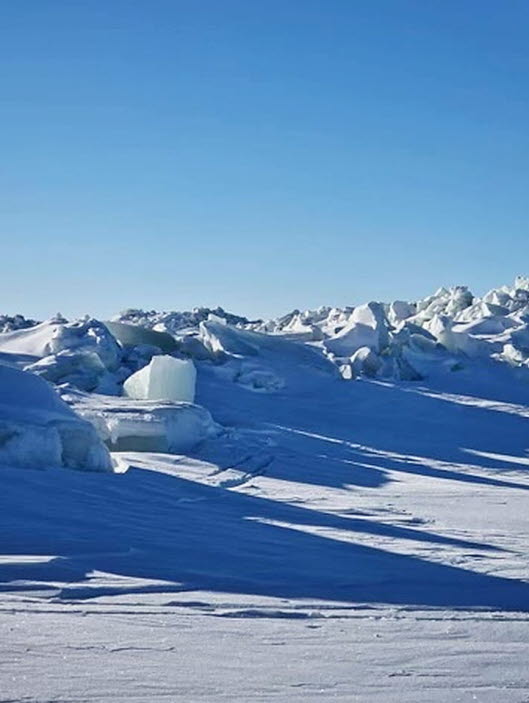
Rafted sea ice caused by strong winds. The areas are marked on the ice chart with two square ‘humps’.