Holmen’s Knowledge forests are large areas of forest with high conservation value that we are opening up to gather and share knowledge about forestry, biodiversity and growth.


Biodiversity in the forest
Biodiversity
Holmen’s nature conservation work combines active forestry with protecting the diversity of habitats and species. The aim is for our forestry to foster biodiversity.
Active measures for thriving forests
Sustainably managed forests with healthy ecosystems and rich biodiversity are crucial for the forest to contribute renewable raw materials to the climate transition. Holmen invests around SEK 200 million annually in forest management. All to ensure good growth and viable ecosystems for future generations.
Forest planning is the basis for active and sustainable forestry. We continuously inventory our entire forest holdings to produce data that is used, among other things, to plan silviculture work and harvesting. The impact of forestry on biodiversity is assessed through ecological landscape planning, which is a strategic planning tool for conducting active forestry while preserving biodiversity. The planning includes climate adaptation through risk analyses and action plans.
Our nature conservation work is founded on three elements:
Environmental considerations in managed forests
Holmen actively manages its forest holdings to increase forest growth and climate benefit. Although wood production is the focus, natural and cultural values are taken into account for every action, based on the needs and circumstances of the site in question. A nature conservation assessment is carried out for each forest stand where thinning or harvesting is planned, in order to ascertain which values should be taken into account. Attention is also paid to protected and particularly high-value species. This is balanced with the conservation priorities from a landscape perspective, so as to achieve the greatest and most effective nature conservation benefits. An action plan can then be drawn up, based on these assessments.
Conservation actions in active forestry form the majority of Holmen’s work on biodiversity. Such actions include saving high stumps and dead wood to provide habitats for wood-living insects and fungi. Buffer zones along watercourses are preserved to protect aquatic species and improve water quality. During harvesting, buffer strips are also left with trees and bushes intact. Large trees, both living and dead, are kept as nesting sites for birds and insects.
Nature conservation management
As a natural part of forestry, Holmen also carries out actions to develop or strengthen nature conservation, for example by conservation burning or removing invasive spruce trees to benefit broadleaves. Conservation burning is carried out to create the fire-affected substrates and environments that have historically shaped our forests, on which many threatened species depend. Holmen also works to restore wetlands and create richly varied forest landscapes. Every year, Holmen carries out management conservation on approximately 400 hectares to improve biodiversity and help create healthy, resilient ecosystems.
Voluntary set-asides
Holmen works to increase biodiversity and strengthen ecosystems by performing actions in formally protected forest and voluntary set-asides. In formally protected areas, such as nature reserves, natural processes are allowed to run without interference, favouring species that require untouched forests. Management conservation is carried out in those habitats that require it to maintain their conservation value even in formally protected forests.
The voluntary set asides differ in terms of how they are managed. Some forests are left completely untouched so that natural processes are able to develop freely, while others require regular management to maintain their nature conservation value. The set-aside forests are spread across all of Holmen’s forest holdings.
Positive trend for forest-dwelling species’ habitats
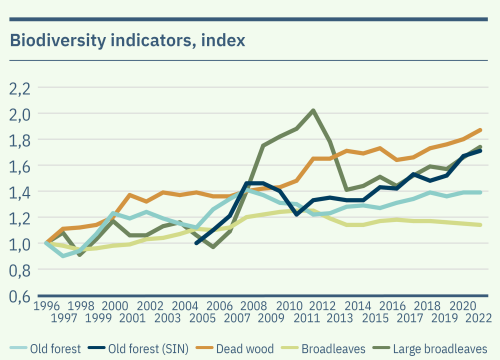
Several habitats important for forest-dwelling species are analysed in order to evaluate the measures implemented. Independent data dating back to 1996 show a positive development over the past 30 years.
The proportion of old forest has increased by 39 per cent.
The amount of dead wood has increased by 87 per cent.
The amount of broadleaves has increased by 14 per cent.
The development is monitored using five biodiversity indicators
Forest biodiversity is affected by multiple factors. Holmen monitors developments annually through five biodiversity indicators that show how these forest habitats are developing:
- Area of older forest
- Area of older forest with special indication of natural values (SIN)
- Volume of dead wood
- Volume of broadleaves
- Volume of large broadleaves
The indicators represent different types of habitats which together provide a broad picture of the conditions for biodiversity on Holmen’s land. The Swedish National Forest Inventory at SLU regularly monitors the condition of Sweden’s forests. The indicators are based on the National Forest Inventory’s data from sample locations within Holmen’s own holdings on productive forest land. The ambition for the selected indicators is a positive trend over time.
When selecting indicators, Holmen has taken into account the Swedish Forest Industries' biodiversity goals and conducted stakeholder dialogues.
Older forest
Older forests are important in several aspects. Old trees host birds, insects, mosses and lichens while being valuable indicators of unaffected soil and field layers, which benefits ground vegetation and fungi.
Older forest with special indication of nature values
Older forests with a special indication of conservation values not only show the age of the forest, but also whether they have special qualities that create better conditions for more demanding species, for example if an area has really old and coarse trees. dead wood and trees of different ages.
Dead wood
Dead wood is important for biodiversity in a forest and serves as a habitat and food source for birds, insects, fungi, mosses and lichens. It is estimated that about 20 percent of all forest species are dependent on dead wood.
Broadleaves and large broadleaves
Broadleaves and large broadleaves are important for birds and rare insect species, both for food and as nesting trees. Aspen, birch and deciduous trees such as elm, beech, oak and maple have a number of mosses and lichens that only grow on each tree species, and then usually only on old and large trees.
Sweden's forests have good conditions for biodiversity
Ahead of the UN Convention on Biological Diversity (COP15), independent researchers from the UK's Natural History Museum developed a biodiversity index that estimates how much of the original number of species and habitats remains.
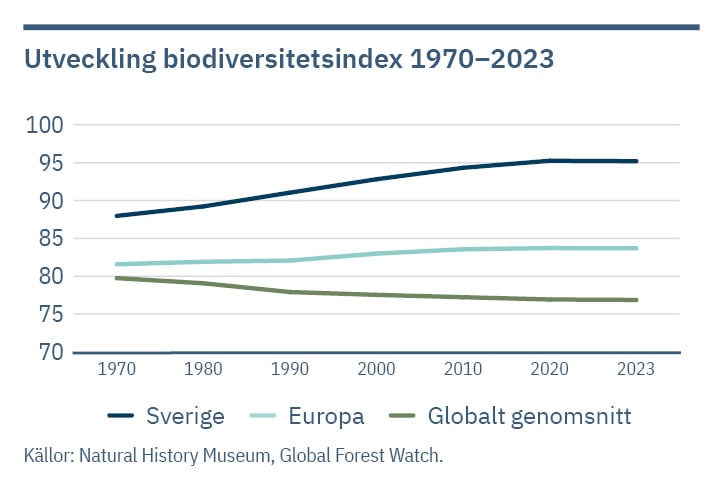
The Biodiversity Index is based on the world's largest database on how organic communities have been affected by humans and is used to monitor biodiversity in different regions.
The desired level of biodiversity in an area is at least 90 per cent, which is to be regarded as a limit value that the biodiversity in an area should not be below.
Together with Finland, Sweden is the most forested country in Europe, with almost 70 percent forest land and a well-developed forest industry. According to the biodiversity index, Sweden also has good conditions for functioning ecosystems with an index of just over 95 percent. The index also shows that the conditions for biodiversity in Sweden have improved over the past 50 years.
Responsible forestry
Many interests have to coexist side by side in the forest – forestry, reindeer husbandry, hunting and outdoor recreation. At the same time the forests provide a habitat for animals and plants. We practise sustainable forestry that balances these interests, today and for the future.
Contact sustainability issues

Stina Sandell
Senior vice President Sustainability and Communications