The best thing we can do for the climate is to help more customers to replace fossil sources with renewables. It is here too that Holmen’s contribution to the green transition becomes most tangible – when our products reduce the need for fossil products and raw materials. In this way, coal, oil, and gas can remain in the ground.



We let the forest grow and give
Forest land is a fantastic asset. It provides a renewable raw material that can be processed into the products needed for a fossil-free future. And at the same time, hydro and wind power can be produced without any long-term disruption to our forestry.
Competition for different forest values leads to stable value growth
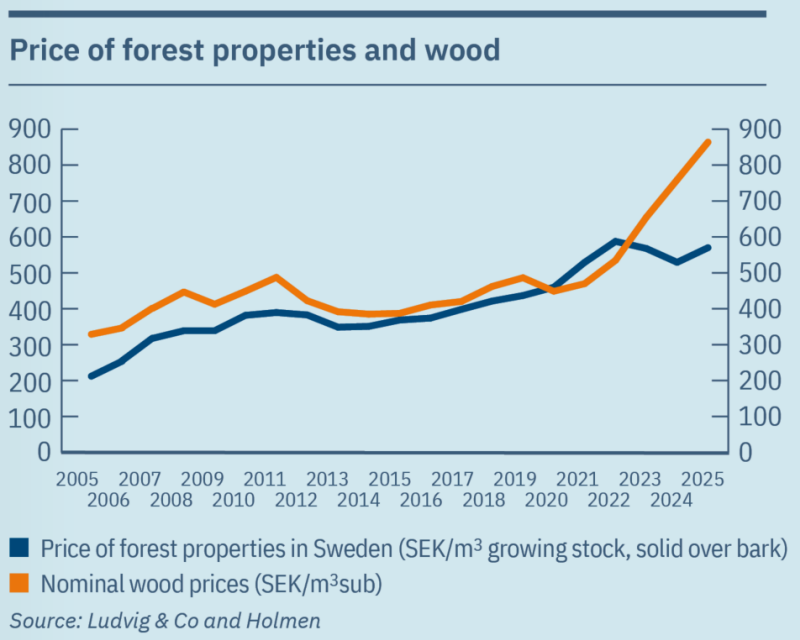
The many values of the forest, from raw material production to carbon storage and ecosystem conservation, make it a sought-after resource. Swedish forest land has long been recognised as a valuable resource and forest property prices have been rising since the early 2000s. A global timber shortage and Russia’s invasion of Ukraine have led to increased competition for wood in Europe, which has pushed up the price of wood raw material in recent years. However, this increase in wood prices has not been reflected in forest property prices.
The debate on the role of forests in the climate transition has intensified recently, with a vocal environmental movement calling for more forest to be left untouched. Nevertheless, the EU’s Bioeconomy Strategy confirms that forest raw material has a key role to play in meeting its climate goals. The European Commission is also working on developing a market for carbon credits that could incentivise forest growth and put an economic value on long-term carbon storage in buildings.
Wood more attractive as climate focus in construction increases
Building with wood has several advantages for the construction industry, as it increasingly focuses on climate considerations. The manufacture of wood products is energy-efficient and the carbon dioxide absorbed by the growing trees continues to be stored in the buildings for a long time. Despite the downturn in the construction industry in recent years, the future for wood construction looks bright in Sweden as interest steadily grows.
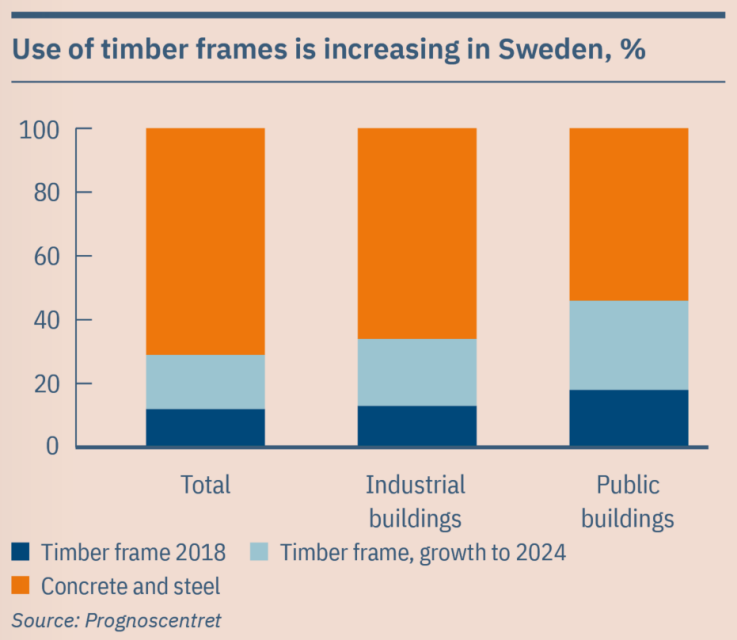
According to a study by Prognoscentret, the share of timber frames in new builds grew from 12 per cent to 29 per cent in Sweden over the period 2018–2024, measured in square metres. Growth is even higher in industrial buildings, with 34 per cent featuring timber frames, and in public buildings, such as schools and healthcare facilities, where timber frames have a 46 per cent market share.
The property sector’s environmental focus is expected to continue to increase, driving up demand for wood construction. There is a broad political consensus that wood construction is good for the climate. The EU has unveiled several initiatives aimed at promoting the use of wood and other renewable building materials.
Lightweight fibre-based packaging more cost-effective
Packaging is fundamental to the distribution of goods and food in modern society, and the amount of packaging circulating in society has long been on the rise. Global growth is being fuelled by an expanding middle class and higher consumption through online shopping and home delivery. Packaging based on paperboard and paper is made from renewable raw material and can be recycled several times to replace more resource-intensive packaging materials. Fibre-based packaging is more environmentally friendly than, for example, plastic and glass, but within the segment there is a wide variation in quality, cost and environmental impact. Customers tend to prioritise the option that most cost-effectively meets the quality requirements.
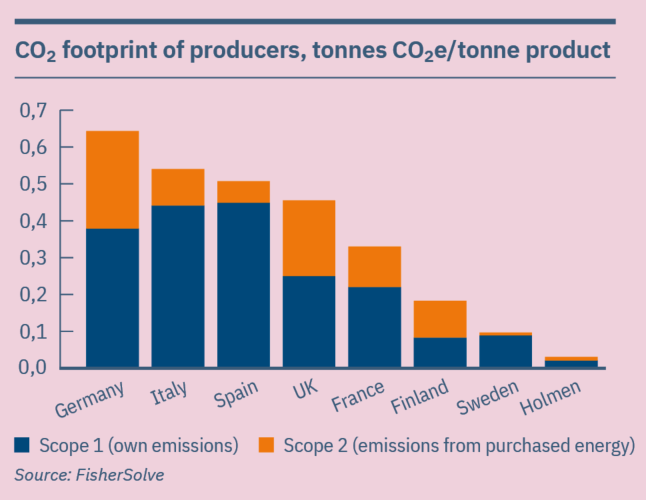
In 2025, Holmen launched an all-new paper product for packaging which offers outstandingly low weight, giving customers more packaging for their money without compromising on quality. The product has the lowest carbon footprint in the market and is approved for direct contact with food.
Potential for more renewables as the EU steps up electrification
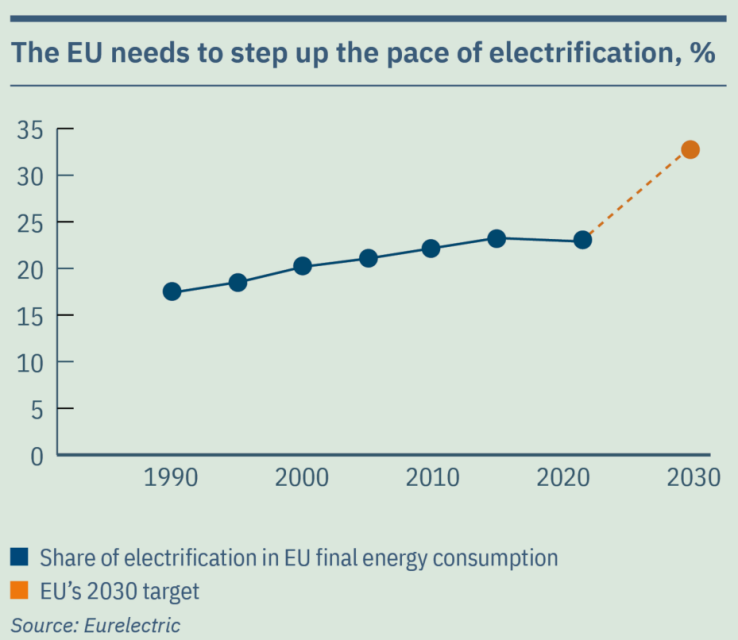
Increasing electrification is essential for reducing fossil fuel emissions. Greater electrification also reduces the need to spend money on fossil fuel imports, which improves energy security. In the EU, electrification has stagnated at around 22–23 per cent of final energy consumption over the last decade. This is way off the EU’s target for electricity to account for 32 per cent of final energy consumption by 2030, a target set out in the Clean Industrial Deal. The European Commission is working to turn the tide by removing barriers and supporting the expansion of energy infrastructure.
With good access to cheap renewable electricity, northern Sweden is a potential location for the establishment of electricity- intensive industries. As electrification gains momentum, Holmen has good opportunities to increase renewable electricity produc tion by scaling up our wind power capacity. On our land holdings, 160 areas have been assessed as suitable for the establishment of wind power and we have around 20 projects in various phases of development, from in-depth analysis to licence application. At the same time, controllable hydro power acts as a battery to ensure a stable electricity supply.