

In the CEO’s message, Henrik Sjölund describes the benefits of the broad transition to rotation forestry. Swedish forests have been managed for centuries. Rotation forestry was widely introduced in Sweden in the 1950s, with investments in post-harvest replanting and the development of silviculture practices over time. This has led to increased growth and rising harvests, while both Holmen and Sweden have built up a large volume of standing timber.
The restructuring of forestry practices has enabled Sweden to build a world-leading forest industry, with Holmen as a key player. Sweden is today one of the world’s largest producers of wood products and fibre products, much of which are exported. The Swedish Forest industry employs around 140 000 people nationwide, directly or indirectly, and contributes with almost SEK 200 billion in export value.
But the high growth in the forest has not just benefitted the Swedish economy. Since 1990, more than two billion tonnes of carbon dioxide have been sequestered in forests and wood products, which is almost as much as has been emitted within Sweden’s borders over this period. At the same time, raw material totalling almost three billion cubic metres growing stock, solid over bark, has been harvested to make houses, packaging, books and hygiene products, while the residual products have been used for heating, electricity and fuel. Renewable products from the Swedish forest have thus helped companies and consumers around the world to reduce their carbon footprint.
Climate benefit calculated in line with new ISO standard
Holmen has calculated the climate benefit of its operations since 2019, using a method that over the years has been refined together with researchers and industry stakeholders. 2025 saw the launch of ISO 13391, an international standard for calculating the climate benefit of the forest industry. The ISO standard provides a science-based, international framework developed in collaboration with experts from 15 countries. This is the method that Holmen uses to calculate our climate benefit.
We manage the forest with the goal of producing as much wood as possible. A positive side-effect of the high growth rate resulting from rotation forestry is that the forest binds more carbon dioxide than it would have done under other management methods. After harvesting, the carbon dioxide is stored in our processed products throughout their lifetime, while new forest grows on the harvested land.
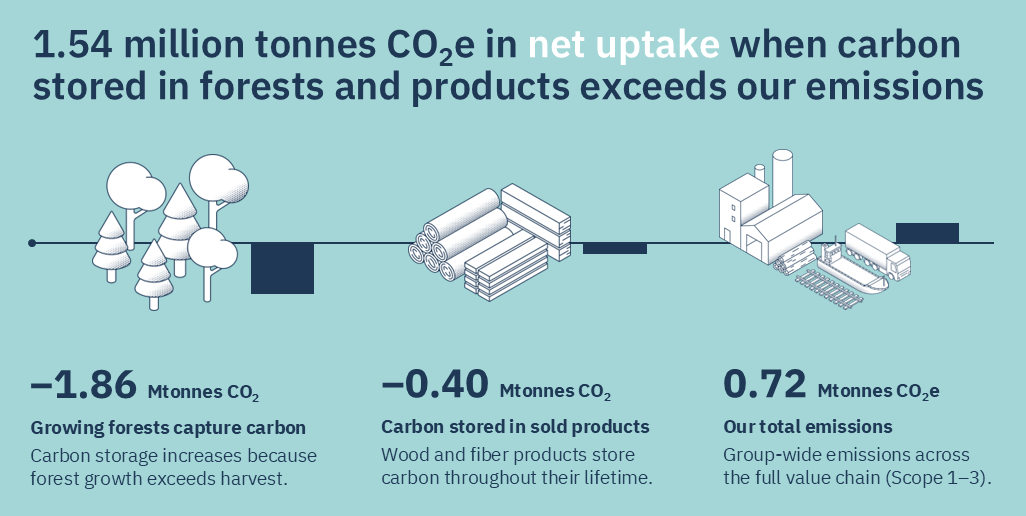
In 2025, Holmen’s net uptake amounted to 1.54 million tonnes of CO2e, when sequestration in forests and products is weighed against our own emissions.
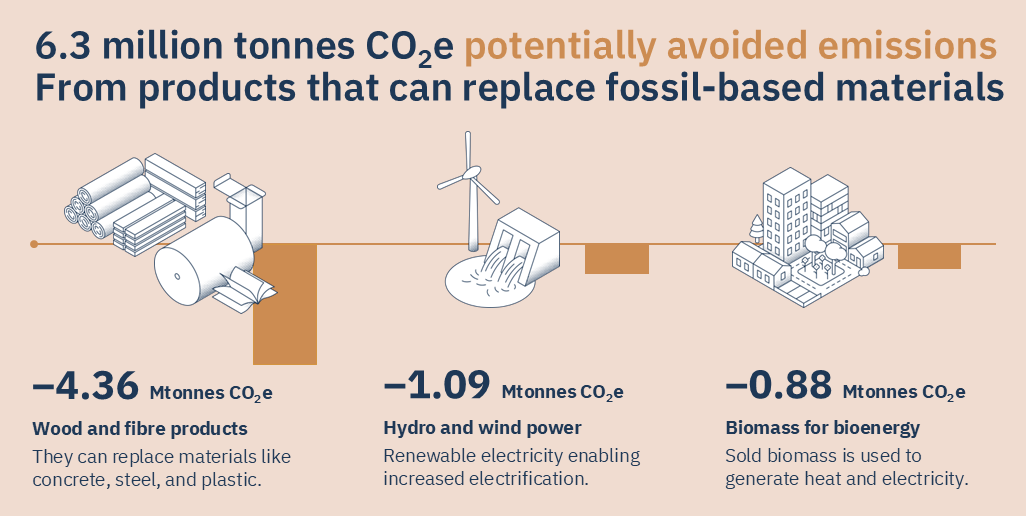
The greatest climate benefit from forests lies in their ability to reduce society’s reliance on fossil fuels, especially when the carbon storage in wood-based products is taken into account. By maintaining high forest growth and harvest levels, the climate benefit increases. The harvested raw material is used to produce wood and fibre products that can replace materials such as cement, steel and plastic. Holmen’s climate benefit is further increased through our production of renewable electricity from hydropower and wind. With Blisterliden Wind Farm in full operation since the turn of 2025/2026, our total deliveries of hydro and wind power amount to 2.2 TWh in a normal year.
In 2025, Holmen contributed 6.33 million tonnes of CO2e in potentially avoided emissions from renewable products and energy that replace fossil-based alternatives.
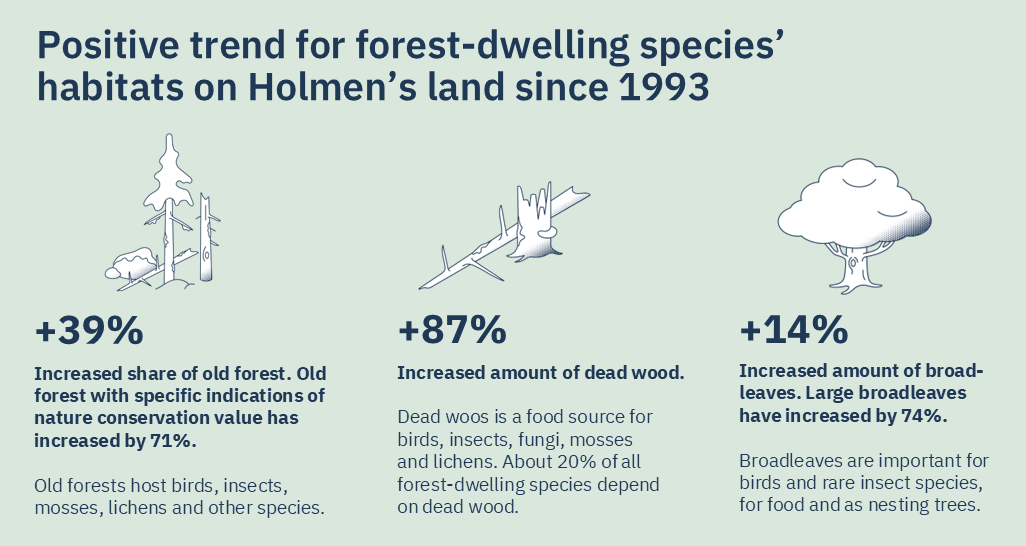
Positive trend for forest-dwelling species’ habitats
Although wood production is the focus for Holmen’s forestry, natural and cultural values are considered for every action, based on the needs and circumstances of the site in question. A nature conservation assessment is carried out for each forest stand where thinning or harvesting is planned, to ascertain which values should be considered. This is balanced with the conservation priorities from a landscape perspective, to achieve the greatest and most effective nature conservation benefits. An action plan can then be drawn up, based on these assessments.
Conservation actions in active forestry form the majority of Holmen’s work on biodiversity. Such actions include saving high stumps and dead wood to provide habitats for wood-living insects and fungi. Buffer zones along watercourses are preserved to protect aquatic species and improve water quality. During harvesting, buffer strips are also left with trees and bushes intact. Large trees, both living and dead, are kept as nesting sites for birds and insects.
Holmen monitors the development annually through five biodiversity indicators. The indicators represent different types of habitats which together provide a broad picture of the conditions for biodiversity on Holmen’s land. The indicators are based on the Swedish National Forest Inventory’s data from sample locations within Holmen’s own holdings on productive forest land. The indicators show a positive trend over the last 30 years.
Read Holmen’s Annual Report 2025 to learn more about our rotation forestry, climate benefit, nature conservation and Holmen’s products that contribute to making renewables work.