

Varnishing in practice
Be it matt or gloss, varnishing, is a way to enhance the surface design and protect the printed surface. There are many possible combinations of printing methods, printing inks, types of varnish and varnishing methods. You can also increase adhesion for film wrap, apply heat seal varnish or reduce permeability.
Methods
There are many types of varnishes, they are similar to printing inks but contain no coloured pigments. The vehicle might be a solvent, drying oil, pre-polymer, or monomer. In addition to the vehicle, the varnish may contain resins, dryers, waxes, or photo-initiators.
The varnishing operation can be carried out before printing (matt varnishing is formulated to have a finish which can be overprinted), during printing (inline) or as a separate process after printing (offline). The varnish is applied on a printing unit or by using a special varnishing unit attached to the press, after all the colours have been printed.
The application methods are:
- Conventional plate and blanket via a normal ink unit
- Modified dampening system
- End-of-press roll coater, dedicated for varnishing
- Multiple-coating units for combination work.
Different types of varnishes
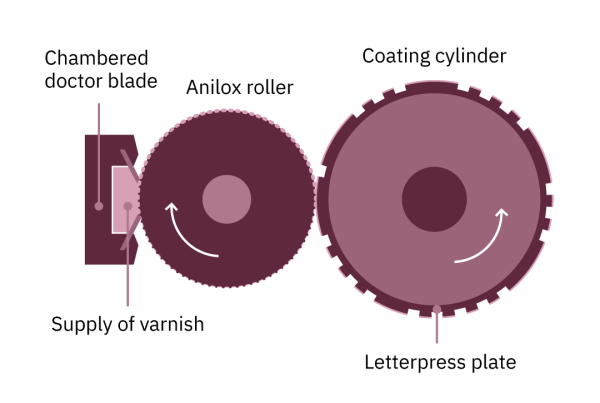
Chambered doctor blade system.
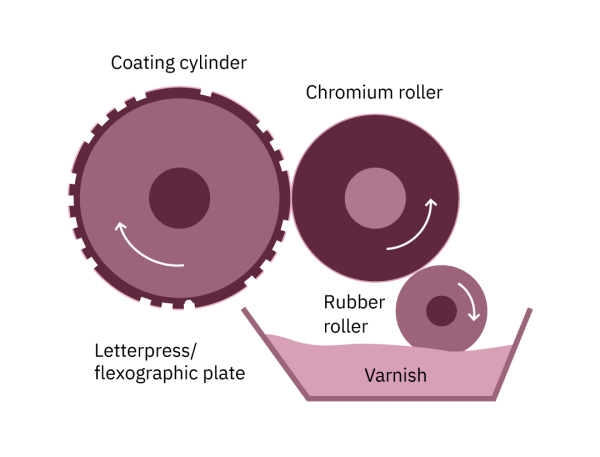
Varnish application with metering roller.
We recommend that you check with your ink supplier which varnish is most suitable for the type of ink you are using, especially if you are considering a UV cured varnish or if you plan to hot foil.
In offset printing the following types of varnish can be used.
- Overprint varnish, which can be described as conventional offset ink or UV ink. The drying takes place with the same mechanism as for quick-setting offset inks, i.e. absorption of the low viscosity part of the varnish and then oxidative polymerisation drying of the vegetable oils.
- Dispersion varnish, which resembles water-based flexo ink. The varnish is applied inline in the printing press in a coating unit and is usually dried with an IR drying unit or heated air.
- UV cured varnish, which can be described as a UV printing ink. The drying is a polymerisation process in which the varnish film is cross-linked with the aid of UV light. The gloss depends on the varnish thickness and viscosity.
- A combination of UV and dispersion varnish for special effects.
The advantages and disadvantages of the different types of varnishes are summarised in the following table. All three varnish types are also available in matt versions.
|
Varnish type |
Advantages |
Disadvantages |
|
Over-print varnish (conventional offset ink) |
High gloss |
Slow varnish drying |
|
Very good rub resistance |
Spray powder necessary |
|
|
Does not affect the paperboard´s dimensional stability |
Risk of yellowing |
|
|
Resistant to alcohol |
Not odour neutral |
|
|
Processable as a printing ink |
||
|
Dispersion varnish |
Very high gloss |
Can affect the dimensional stability of the paperboard |
|
Very good rub resistance |
Resistance properties have a limited lifetime |
|
|
Quick drying |
Alkali-resistant inks necessary |
|
|
None to very little spray powder necessary |
||
|
Odour neutral |
||
|
Deinkable |
||
|
No risk of yellowing |
||
|
UV varnish |
Highest gloss |
Odour neutral under some conditions |
|
Best mechanical and chemical resistance properties |
Content declaration necessary (skin irritating) |
|
|
No spray powder necessary |
Limited deinkability |
|
|
No set-off in the stack |
High varnish cost |
|
|
Difficult to apply inline with conventional inks |
Recommendations
The key paperboard properties to consider for varnishing are the same as for printing. Since gloss varnish is used for the purpose of reflecting light in a uniform way, the result depends on a very smooth and uniform paperboard surface. To be able to reflect and retain as many colours as possible, the whiteness of the board is also crucial. These criteria are well fulfilled by graphic paperboard. To avoid blemishes, the surface of the paperboard must be clean and especially free from dust or anti-set-off spray powder.