Holmen’s Knowledge forests are large areas of forest with high conservation value that we are opening up to gather and share knowledge about forestry, biodiversity and growth.


Treetops
Sustainable forestry
We use the forest actively and sustainably so that it grows and provides renewable raw materials for generations. With circular methods and a focus on biodiversity, we create climate benefit, economic value and healthy ecosystems.
Swedish forestry – a success story
Swedish forests have been harvested for several centuries. Since the 1950s, industrial forestry has been carried out in Sweden, with investments in reforestation after harvest and gradually developed forest management methods. This has led to increased growth and rising timber stocks, while the amount of harvested forest has increased. Since the 1990s, greater attention has been paid to biodiversity, with more trees left standing during harvests and more areas left untouched.
Long-term, active and responsible forestry creates a unique combination of climate benefits, economic value and nature conservation – a success story that makes Sweden one of the world's leading forest nations.
Sustainable forestry
Forests are crucial for the climate transition
The climate benefits start in the forest, where trees absorb carbon dioxide as they grow. By managing our forests actively, we enhance their long-term climate contribution – primarily because forest-based products replace fossil materials. Active management also helps trees grow better.
A long-term and rational management of our forests has contributed to an increasing timber stock and higher yields over time. A growing timber stock binds and stores carbon, and after harvest, the forest raw material continues to provide benefits by storing carbon in long-lived products such as planks and wooden frames, and by replacing fossil-based materials with higher carbon footprints like steel, concrete, and plastic.
According to estimates for 2024, the total climate benefit from Sweden’s forest sector amounts to 97 million tonnes of CO₂ equivalents (CO₂e). This can be compared to Sweden’s total emissions of 47.5 million tonnes in 2024. Holmen’s contribution that year was 8.3 million tonnes of CO₂e. The carbon uptake in our growing forests and the storage in our products alone are three times greater than our total fossil emissions.
Great demand for forest raw materials
Although forests are a renewable resource, the supply of raw materials is limited in several parts of the world and the global supply of timber is increasingly strained. Canada has been hit by large bark beetle infestations, which has reduced the annual harvest while the country is severely affected by forest fires. In Europe, spruce bark beetle infestations have forced large parts of Central Europe to take care of infested forests.
The war in Ukraine has also affected the supply of wood raw materials on the European market as wood imports from Russia and Belarus have been stopped by EU sanctions. In recent years, the supply of forest raw materials has not been sufficient to meet the needs of the forest industry and the energy sector. Competition for the raw material is fierce, which has meant that Swedish timber prices have risen sharply.
Clear-cutting forestry
Clear-cutting forestry has been the dominant forestry method in Sweden since the 1950s. The method is based on the rejuvenation of the forest through planned final felling, which provides high growth, stable timber production and good economic returns over time.
The aim is to create a balanced age distribution in the forest, from newly planted to ready for felling, which provides an even and predictable timber production year after year.
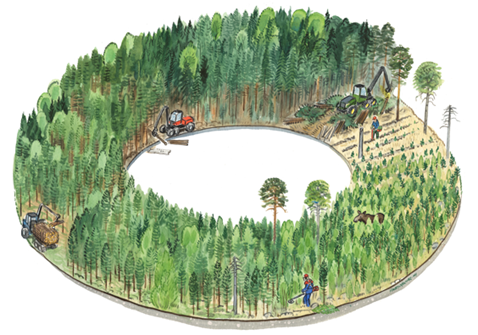
Clear-cutting forestry is similar to the natural processes that have shaped the Nordic forests, where fires and storms have regularly created new regeneration areas. By mimicking these natural disturbances, the method can preserve ecological values while contributing to a growing bioeconomy and increased carbon sequestration.
In short: Clear-cutting forestry is a rational, sustainable and nature-adapted way of managing the Swedish forest.
Sustainable and responsible forestry (in swedish)