

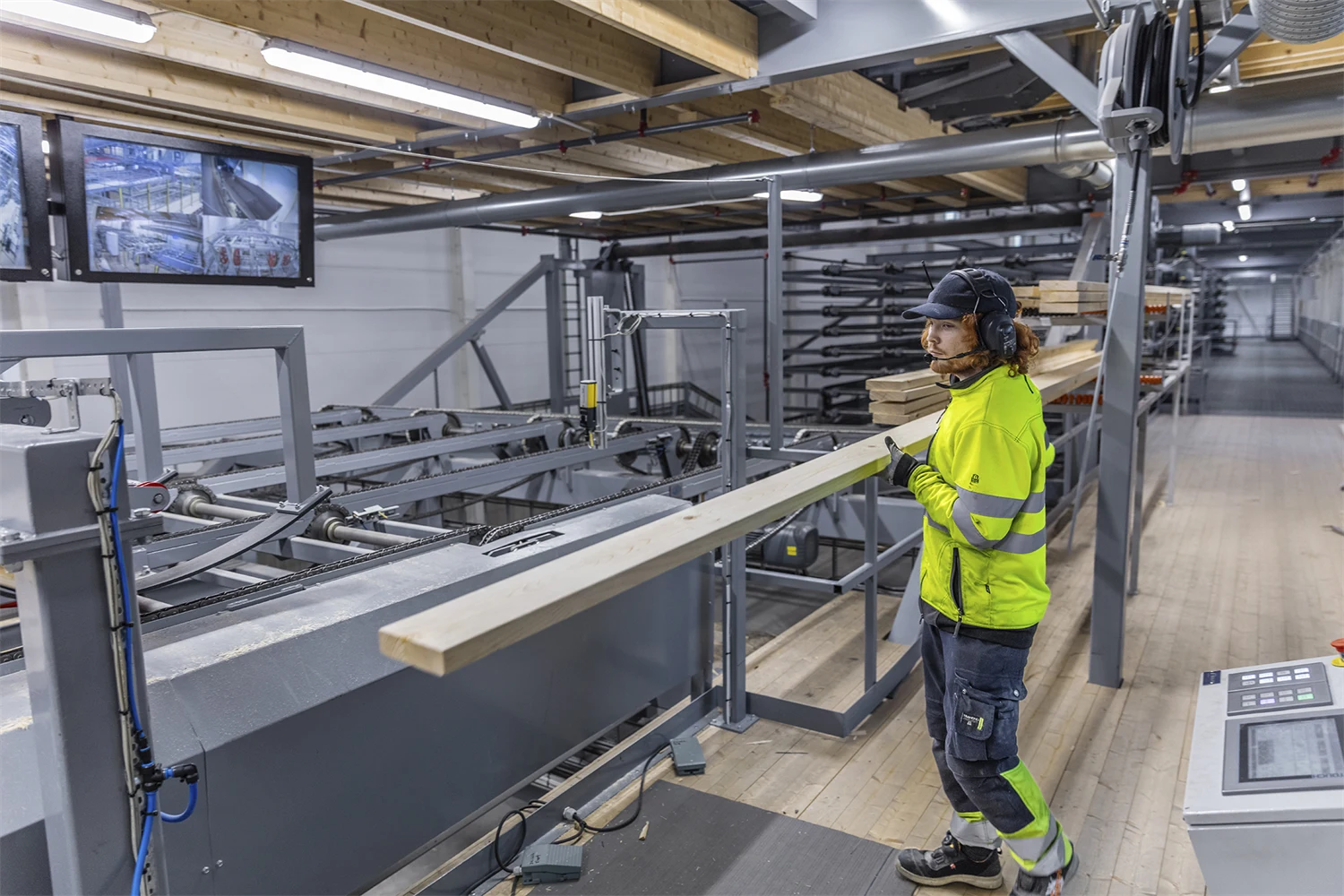
During the autumn, Holmen Forest harvested around 50 000 m3 sub* of the lodgepole pine that grows in the forests of Hälsingland. One third, comprising the smaller logs, was shipped by sea to Linghem Sawmill, while trucks took the rest to Iggesund Sawmill. However, lodgepole pine is not a new tree species for the two mills. In 2023, lodgepole pine products were test-sawn in Iggesund, before being planed in Linghem for certification for the European and US markets.

Mikael Karlsson, mill manager in Linghem
“When we found out that we’d be receiving our first delivery of these pine logs, we set up a lodgepole pine group in Linghem with representatives from all the production sections. Among other things, the group developed a template where the shift teams could fill in how the runs had gone and the settings and values they had used. That way we could learn as we went along,” explains Mikael Karlsson, mill manager in Linghem.
There was also a study visit to Iggesund Sawmill, which already had experience of sawing lodgepole pine.
“We wanted to know what we needed to think about and how we could prepare. Learning from their experience gave us a solid foundation, ready for the first delivery of lodgepole pine to arrive,” says Mikael.
Linghem Sawmill carried out its first commercial run of lodgepole pine in early October.
“There’s always an anxious moment when you run a new product, but we were as prepared as we could be and knew in advance what problems might arise. There’s not really a huge difference compared to Scots pine – lodgepole pine is maybe a bit more brittle,” explains Mikael.
Iggesund was also well prepared when the timber trucks arrived.

Magnus Malmström, mill manager at Iggesund
“During the trial sawing two years ago, we did all sorts of tests to see what works well and what doesn’t, and we learnt a lot from it. Now we’re using that experience, as well as making adjustments specifically for the logs we’ve received this time round, and we’ve continued to fine-tune the process,” says Magnus Malmström, mill manager at Iggesund, where major investments have been made recently to enable the sawmill to handle more tree species.
The runs in Iggesund have gone extremely well.
“Lodgepole pine isn’t as strong as Scots pine and spruce, and has more branches, which means there’s a little more breakage,” says Magnus.
At Iggesund, the lodgepole pine is sawn alongside other tree species and then planed in slightly larger batches, while Linghem has what they call campaign runs. Both mills have also become lodgepole pine certified, and the first cargo of lodgepole pine products will soon depart for the US.
“If we can maintain the quality at the right price point, lodgepole pine could prove a great addition to Linghem’s portfolio,” comments Mikael.
Holmen Forest’s plan is to continue supplying lodgepole pine to the sawmills in the fourth quarter – the low season for builders’ merchants – in the coming years.

Mattias Forslund, acting Head of Industry
“Having production of lodgepole pine products at several units is a real strength. It means that more people are involved and more technical solutions are being tested – and we avoid raw material shortages,” says Mattias Forslund, acting Head of Industry.
Lodgepole pine is a common tree species in the US and one that is widely used in the construction industry.

Marketing Director Johan Hedin
“Its common name reflects the fact that Native Americans used it to make poles for their lodges, indicating just how long it has been used for building. The construction products may eventually be sold in Europe as well, but at present this type of wood isn’t used in the construction industry here,” explains Marketing Director Johan Hedin, who continues:
“The centre yield products, the planks, will therefore mainly be planed, strength-graded joists for sale to US builders’ merchants. The side boards will be sold mainly to the packaging industry in Europe and North Africa.”
* sub: solid under bark. Describes the volume of wood, excluding both the bark and the space between the logs.