

Plastic-free ID cards
Graham Lycett is the Managing Director of Jellyfish Livewire, a marketing agency that specialises in the management of card manufacture. He has been on mission for several years to eliminate plastic cards and he uses Holmen’s paperboard for this purpose.
“With our Green Card brand, for example, we helped move UK retail from plastic to paperboard-based gift cards,” says Lycett. “We were one of the pioneers. And now, most gift cards sold in the UK are made of paperboard, mainly Invercote.”
Paperboard cards
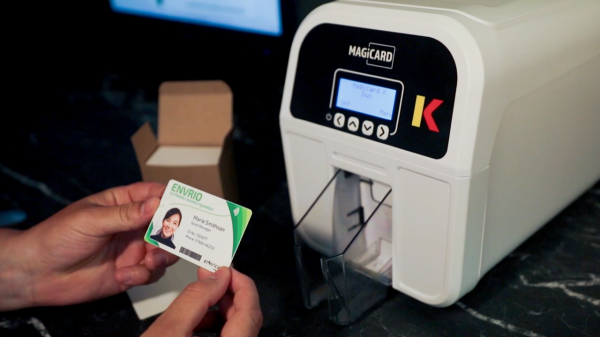
Lycett’s next step was to launch enviricard. Made from Invercote and other completely natural materials, it has huge potential. “The enviricard is a plain white card which is compatible with a range of existing desktop printers and ink ribbons that are used around the world to make instant staff ID, visitor or membership cards,” Lycett explains.
“They can be plain white or pre-printed and with or without technology. And it has a negligible carbon footprint.”
37 billion cards each year
The aim is to sell hundreds of million units annually of the patented enviricard. And the market is there. In its most recent study into the number of cards produced globally, the International Card Manufacturers Association concluded that around 37 billion cards were made annually. These include ID and membership cards, bank cards, pre-paid phone cards and transportation cards.
“This results in a significant amount of CO2 production which is completely unnecessary,” Lycett says. “We don’t need plastic for the vast majority of cards, paperboard is just as good. And Invercote has proven itself to be more than robust enough for card purposes. We believe therefore that 9 billion cards could be phased out overnight with our product.”
Eco-friendly ID cards
The key to enviricard’s potential success lies in its compatibility with existing desktop printers. “We had to replicate the same characteristics of plastic so that it would work with existing printers and ribbons,” Lycett says.
“The only way to drive change is to not create barriers. It has to be easy to adopt.”
Through significant R&D and some trial and error, Lycett found a natural polymer made from renewable resources, such as corn starch, that replicated the plastic used on the cards. The cards with the coating were tested with printer manufacturers who endorsed the new product as being compatible with their existing equipment.
The importance of partnerships
Driven by Lycett, enviricard is the result of input from various partners. “The specific polymer comes from a European partner,” says Lycett. “It is applied to Holmen’s paperboard by Celloglas, a specialist laminating partner in the UK. The sheets of Invercote with the coating are then sent to another partner who punches out credit card sized cards which are then boxed and ready for distribution.”
All in all, enviricard has become an eco-friendly alternative to the standard cards used for multiple purposes in everyday society. It offers a great opportunity for plastic id cards replacement. Find out more about enviricard here.